Posts

Make Yourself Look Good Online (Week 7)
Image
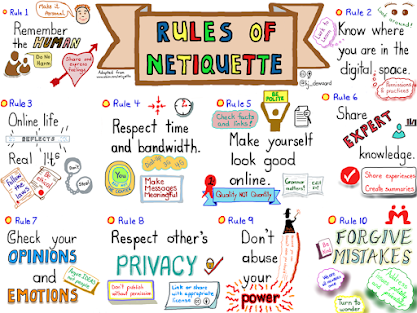
                In real life, we - people follow some ethical codes in order to respect someone and in return get the same kind of treatment from them. This term is called etiquette and it comes from the word “étiquette” which means ticket in French. Now when referring to cyberspace, this term itself changes into netiquette and includes some main rules that are worth to be followed. Initially, it is presumed that netiquette was used in Palo Alto Research Center in between the 70s and 80s  [1] .   To further spread these rules, Virginia Shea released a book called “Netiquette” which mainly focuses on ten fundamental rules that are to be followed in modern cyberspace. In the following paragraphs, I will mostly target the 5 th rule which is “Make yourself look good online” and give a few examples about it. Make yourself look good online [source: https://www.pinterest.com/pin/218354281917321230/ ] What do we mean by saying “mak...

Analysis of the Types of Copyleft (Week 6)

Image
          Most people who spent their time on open-source projects are familiar with the term “copyleft”. This term itself is widely used in many areas; however, some people may not understand what it is. The word copyleft was firstly used in Li-Chen Wang’s Tiny BASIC program in 1976  [1] . It is now mostly known as a way of giving a permit to freely publish and change the source code with condition that those same rights will be maintained in other works that will derive from the original resource  [2] . Furthermore, copyleft is a concept that is often used in the details of a particular copyright license  [3] . A few of those examples are GNU General Public License (GPL) and the Creative Commons Attribution Share Alike License. In addition, copyleft consists of three different kinds: strong, weak, and no copyleft. Now that we understand what copyleft means, in the following paragraphs I will analyze how these three different types of copyle...

Review of "The Case for Copyright Reform" (Week 5)

Image
  [source: https://www.eea.europa.eu/legal/copyright ] In the modern world, copyright is an essential part of the information that is hovering around the Internet. Some people follow it, but others try to bypass it by creating a “pirate” copy of the data and releasing it for free on various websites like “The Pirate Bay”. To further investigate this matter, I will give some opinions about the ideas that were presented in “The Case for Copyright Reform” which was written by Rick Falkvinge and Christian Engström. The authors introduced 6 main points which summarized their proposals: §   Moral Rights Unchanged §   Free Non-Commercial Sharing §   20 Years of Commercial Monopoly §   Registration After 5 Years §   Free Sampling §   A Ban on DRM   The first idea suggested that there should be no changes to the understanding of the real author. People who are responsible for what they have invented or created have to be known as the or...

Review of “Challenges of Global Information Society” by Pekka Himanen (Week 4)

Image
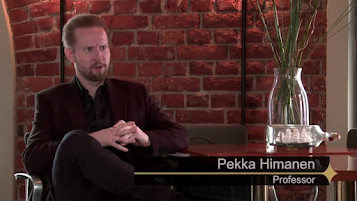
                                                                       [source: https://www.youtube.com/watch?v=r5YNikq6IsU ] Pekka Himanen is a Finnish philosopher who is internationally known for his research and who has been involved in writing and editing 15 books and articles  [1] . He has finished his Ph.D. in Philosophy at the young age of 20 which is really surprising because most people these days finish their Bachelors in their 20’s or so  [1] . I have read his report called “Challenges of Global Information Society” and I was really interested in hearing the issues and predictions that he mentioned in that paper. In the following paragraphs, I will review his work in more detail and also mention whether his forecasts regarding the future have come throug...

How Wikis Influenced Encyclopedias (Week 3)

Image
              A Wiki is a publication that can be edited by multiple people and sometimes is guided by its readers. Furthermore, typical Wikis have a broad discussion about the subjects which may be a helpful piece of information for its audience. In the modern world, most people use Wikipedia as a way of understanding the desired subject, especially if they do not want to spend much time researching elsewhere. It is also noteworthy to mention that when we search for some topic or subject on Internet the first webpage that we mainly see is Wikipedia, as well. To broaden this topic, I would like to analyze how Wikis impacted its area which is commonly known as an encyclopedia. Wikis to Encyclopedias          The encyclopedia is either a book or multiple books that can assist people in learning a single or many subjects in a detailed way  [1] . As we can see from the definition of ...

Two Technologies from the Earlier History of the Internet (Week 2)

Image
              As a daily user of the Internet, I have always thought that it is something that was created 2-3 decades ago and presumed that its origin was the creation of Tim Berners-Lee called World Wide Web (WWW).   However, I was wrong regarding the Internet’s early history after helpful research which made me realize that Internet has a quite long history than two or three decades. Additionally, I have noticed that some of the technologies that were created in the early history of the Internet are still in use, while some of them have become obsolete and been replaced by modern technology. In the following paragraphs, I will introduce those technologies and briefly discuss their history and use. 1. Finger             Finger is one of the first computer networking tools which allowed a user to see some other user’s information while having the same computer sys...

Three Interesting examples of IT Solutions from Three Different Decades (Week 1)

Image
     Throughout the years, researchers tend to surprise us with several inventions of IT solutions. Furthermore, all of us use at least one of them during our daily life. Referring to the previous idea, it is hard to believe for us to get our day done without the use of any kind of technology. Besides the technology that is surrounded by us, there are other IT solutions that we most likely have never heard of and these inventions may come from various decades. To keep you informed, I have gathered some details regarding three fascinating examples of IT solutions that are all from different decades. 1. CAPTCHA      CAPTCHA (Completely Automated Public Turing test to tell Computers and Humans Apart) is a way of distinguishing humans and robots  [1] . It was invented in the year 2000 at Carnegia Mellon University  [2] Over years these CAPTCHA types started to evolve, and different kinds started to emerge. Furthermore, people started to confuse CAPTC...